Monday, 17 December 2012

What to buy: Tesco Finest* favourites (third part)


A sun blessing of a nice shopping, all done with Tesco Finest*
goods: Conchiglioni, Italian extra-virgin olive oil, Ciabatta bread,
Spanish Mancego cheese, tea scones, Swiss mint dark chocolate.

This post starts with me nibbling at a Tesco Finest* cherry tomato. A gentle sun, albeit mid December, casts its rays onto the only plant my flatmate and I dare taking care of: a purring Leopard Lily. To enrich the quality of the soil, I tried to mulch it with corks. I fancy perhaps the illusion that the different bouquet, trapped inside this delicate oak wood, will help the Lily to grow better. I also fertilized the compost with some exhausted coffee powder, which provides some azotised components.

Leopard Lily and her collection of corks,
as you take care of your plants, day by day, attention
after attention, you have to do the same with food,
every little helps, I would say, distorting Tesco motto.

Anyway, before moving to Waitrose, I find interesting to share the products I appointed to indulge with. Some are belonging to the best British tradition such as relish and butter biscuits; butter squash; marinated beetroots; crackers for cheese; teas and bakery products like scones and crossed buns; mint chocolate and ravishing cakes (cheese cake, black forest and the lemon tart); creamy yogurts; butter (although alas produced in Normandy); and finally sausages and crisps:

Reduced to clear, 0,65£ instead of much more.

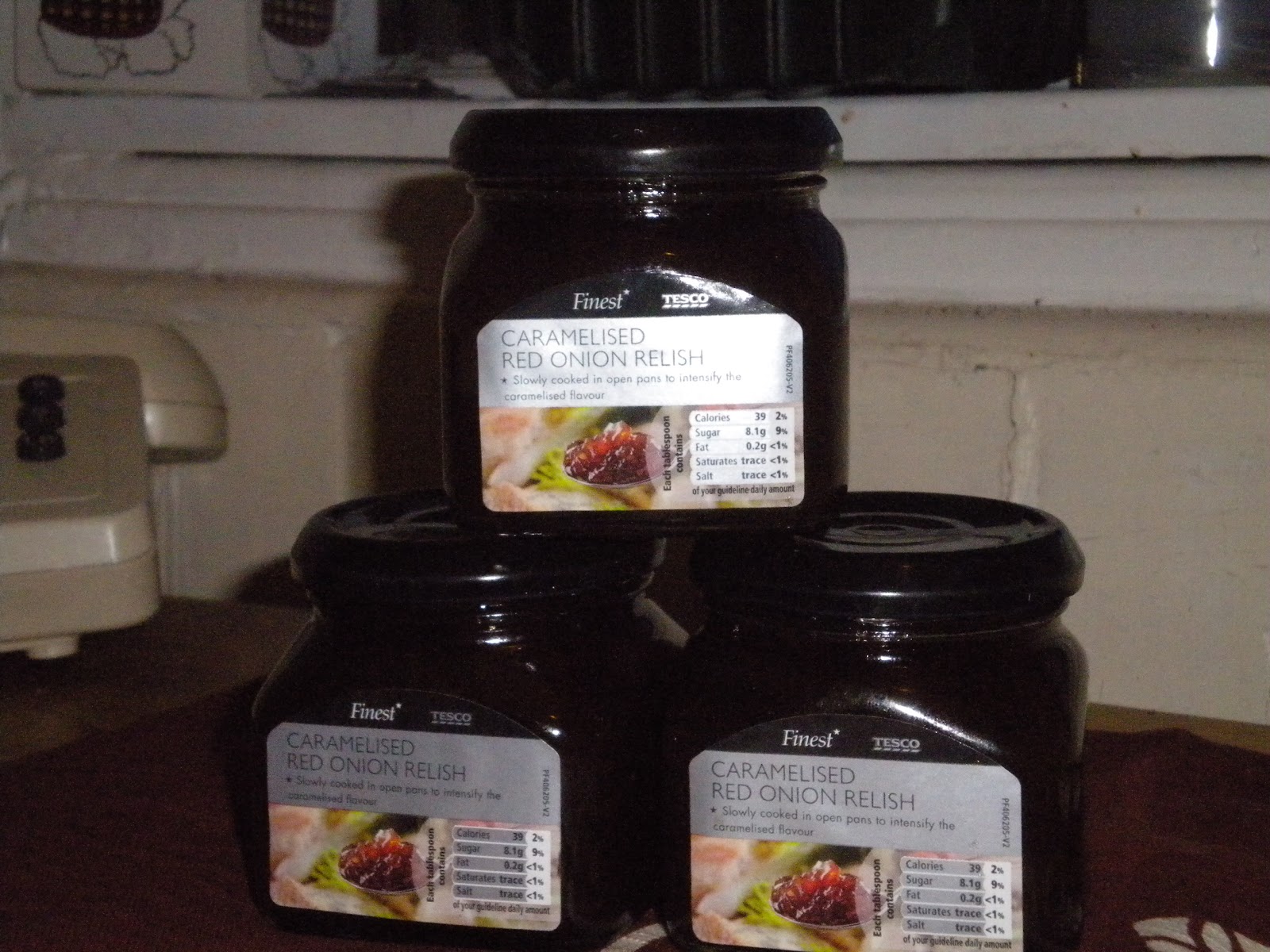
Three for two of red onion relish: 2,20£ each jar.

Paquito squash, price according to the weight, very nice if rosted and served with balsamic glaze.

A comparison between chipolatas  [right] (2,50£) and highland venison sausages [left] (approximately the same price):
both irresistible and it is nice to combine them together.

Some others are keen selections of continental foods, which the British climate discourages to produce, such as wine, oil and olives, South American nuts; fair traded coffee and cocoa; buffalo mozzarella, cherry tomatoes and sweet peppers, durum wheat pastas (as Conchiglioni, Pappardelle and Orecchiette) and egg fresh ones, French, Italian, Swiss and Spanish cheeses and platters of salami; breakfast international choices as Granola and Muesli. What I mainly noticed is the fact niche products cannot be adapted to the British taste, and I am not entirely sure if these goods are meant to keep the continental attention alive. Tesco fears to lose its loyal customers by becoming too choosy.

Pumpkin ravioli with amaretti...mouth watering,
2 packs for 3,50£. Not bad.

Nut Granola, usually 2,65£, I was lucky to buy it for 2£.
Quite enjoyable with organic whole-milk!

Bleu d'Auvergne: a purchase done my flatmate Frederick,
price unknown, but the taste is closer to gorgonzola, and the cheese texture is creamier than
Stilton.

Orecchiette, 1,65£ usually, but these were buy two for one, and I combined them with Pappardelle Tesco Finest*.

The quality of these products on the whole is particularly high. The goods are very well crafted and as I was objecting in two posts ago, the packaging could me more environment friendly, but it is amusing for the eye: the platinum colour instinctively reminds the perception of a jewel.

Two pains au chocolat, reduce to clear at 0,95£.

Three cheeses at the price of two: I choose Stilton, Larcevau Ossau-Iraty and Taleggio (picture bottom left). Also the rosemary focaccia is a Tesco finest product, reduce to clear at 0,95£.

Taleggio, supreme for Risotto & rosemary

Sweet mini peppers: 1, 29£, if I am not mistaken! They contribute to enrich especially Quorn preparations.

My opinion is that Tesco has to deal with a mixed range of customers: the branding is an important stage to bring into the visual mentality of some lazy customers a new product. Tesco Finest* is like a bell that rings to the ears of those who might be uncertain and unsecure of what they are buying but they blindly trust the Tesco selection. For this reason, even if the price of the Tesco Finest* merchandise is more expensive than everything else, still it is reasonably competitive. For instance instead of six croissants you will have two, but the quality of those two surpasses the six paperboard-ish ones you may happen to buy cheaper. For instance, I had the pleasure to buy these croissants at 1,33£ because they where under “price drop” on Sunday 16th December 2012, and the label states it is an improved recipe.

1,33£ instead of 1,99£, price drop + promotion,
because it is new improved produce: 4 French Butter Croissants,
if you wrap then in foil and warm them up they are gorgeous,
if you warm them up without foil they are outstanding!
Tender stem broccoli, steamed or fried they taste delicious.

The penultimate consideration I wish to offer is the fact that Tesco Finest* goods have a short ingredient line: this implies that the quality of produces is better because the ingredients are less, like when you make your food at home. The use of preservatives is reduced only where it is indispensable and Palm and coconut oil is practically banned. Palm oil is a nightmare for developing countries, because it is procuring high levels of deforestation and “fattening” - especially in Africa - few landowners, corrupted governments and multinational groups.

Deliciously buttery shortbread biscuits: 1,39£ 

A short ingredient line encircled in red.


1,50 £, excellent salty butter,
unfortunately produced in Normandy,
despite the UK offers amazing butters.

Buffalo mozzarella from Neaples and surroundings, 2 for 2£:
usually it is 1,75£, each.


Lastly, it is always a good tactic that of approaching expensive produces when they are on special offers. At that condition, the majority of the items are not solely more economical yet fairly convenient for treating oneself and for storage: especially when you have the chance to freeze some commodities or to eat them one day after purchasing. This is also a great moral exercise to avoid compulsive and hedonistic shopping, because spending money on expensive food does not really unravel problems, which aren’t usually solvable throughout mechanical expedients.

Actually this Albacore tuna steak was turn off:
certainly better than John West, it is not exactly what i was expecting.
It is very rare to find good tuna tin in the UK!
Yet it is admirable this tuna is allegedly fished with
pole and line, 2,39£, price drop!

Beechwood smoked ham from Trieste, the frontier between Italy and Croatia, 1,99£, price drop!

King size prawns: excellent with avocado and lime juice,
2,50£, half price!

Ibleian extra-virgin olive oil: rich and elegant,
from the hills of Eastern Sicily, 6,99£


Riesling wine: quite fragrant with a flowers bouquet dominating: refreshing and expressive. On the palate its slightly off dry, acidity is highlighted by vegetables, fish and white meat courses. It gives a jam sweetness, with an aftertaste of delicate bitterness. It is not disappointing, considering it is an imported whine with a capsule cork.

Who's responsable for this modern and audacious way of thinking: a man who was knighted in 2002 and brought Tesco to the podium of the three most fruitful companies in the world, his name is Sir Terry Leahy, as the Beatles he is from Liverpool. He was brought up in a council estate and became gradually and successfully who he is, but he never forgot the hard times of his starting point, and now he points out how the public school system should be reformed:


Tesco Chief executive, Sir Terry Leahy,
ordinary greatness

Thursday, 13 December 2012

Where to shop in Edinburgh: The Finest* addiction (second part)


Why then I appointed Tesco then?  (My) Ignorance, (a logistic) convenience, and (the company) philosophy are the answers I left in suspension at the end of last post. The first answer - which is also the most laughable - is that in 2007 I didn’t know Waitrose existence (which is increasingly becoming my favourite point of alimentary reference). Waitrose is more a European bazaar, so to say: there you can find the best selection of every sort of international goods, and I guess European travellers appreciate it more, because of its multicultural and non-filtered flaunting of products. Moreover, Waitrose is pushing further the Organic battle, line that I appreciate a lot. 

Detail of Effects of good governance by Ambrogio Lorenzetti, 1338-1340,
Palazzo Pubblico, Siena. Organic farming means essentially an holistic and ecologically
balanced approach to farming, avoiding the severe usage of specific chemicals.
http://en.wikipedia.org/wiki/Organic_food
Waitrose acquired Duchy the brand once owned and launched by HRH Prince of Wales, Duke of Cornwall. Waitrose licensed the brand that was suffering substantial losses, due to the abrupt fall of organic sales and because the organic inclination is now satisfied by a wider spectrum of goods at lower prices. Waitrose now pays royalties on sales, so it is basically the market which will decide and the food-industry-chain is more rationally organized. I shall come again on this subject, because I tend to appreciate both the Prince's efforts and the solution achieved.


Let's head back to the primary argument: why Tesco? Proximity made the choice simpler! Morrisons, Asda, Sainsbury’s and Marks & Spencer were too far from Warrender Park Road (where I used to live) and - at that time - I wasn’t shrewd enough with the online shopping:


If Waitrose is more open to contaminations, Tesco, Sainsbury’s, Marks & Spencer are, instead, more essentially British: they fear to detach too much from what British people are believed to fancy. I should devote a page to them as well, sooner or later! It is virtually impossible to shape a personal idea, without shopping in all of these places. Especially to signal those asperities related to employment factors, often debated within the British society, but under surface for foreigners.

http://deanvipond.com/blog/?p=129
This blog offers an interesting angles about brands and capturing words.

The second reason I picked Tesco then was its relative closeness. Lastly, it was extremely evident its selling angle: there are essentially three streams of products and it's easy to stuck to what we understand. Everyday Value (once Tesco value) is thought to help people save money. The brand’s motto is Every little helps, which pays its debt to the hard discount initial vocation "pile 'em high, sell 'em cheap". It is a foul play - for my taste - the use of the word value: the effect is that of stressing on the reduced cost, yet alluding to a sneaky ethical field. The high abuse of Palm Oil, Sugar, Salt, Preservative and Fats does not really make these goods appealing, neither to my palate nor to my environment friendly inclination: they aren’t poison, but definitely not ambrosia.
In my opinion this line of products is too shabby in presentation and quality,
there are wonderful exceptions related to foil, cling film, oven paper (non edible stuff)
Then there’s (standard) Tesco, which offers a good range of merchandise, but too many ready meals, which encourage people’s laziness and uncritical attitude. If you ignore how to cook something, you cannot judge it. On the other hand, Tesco seems attentive to local products, which on the average is a good effort. I noticed, for instance, that Waitrose, here in Scotland, privileges English meat to the Scottish one, which is fine, but does not help to create a short food chain. 
http://realfood.tesco.com/our-food/tesco-standard.html
Here what the brand itself states on Tesco standard


Finally, we have Tesco Finest, which I would like to define REAL FOOD: Tesco Finest* is actually able to challenge - in terms of prices and qualities - with M&S and Waitrose best items. Only how consumers will enact (or “inact”) is going to force food groups to diversify – according to more respectful policies - their goods assortment. I have to admit it: I am in love with Tesco Finest*. Not even soups are a turn off. This addiction is beneficial and healthy and it teaches a little lesson: good food costs only a bit more than sub-standard food, but it is also important not to make it become a fetish. Tesco Finest* is a combination of knowledge, expertise, care, quality and choice: not an easy goal:


Sometimes, I got almost offended by the co-existence of shoddy goods and excellent ones. It is unfair: it is a shame to acknowledge how many superb aliments Great Britain has and trades and how miserably low is its food reputation. Moreover, I disagree with the market rule of demand and offer: if you invest in the organic philosophy, fostering an ideological battle, those organic goods will cost less and even who is not aware of what she/he is eating will feed her/himself better. Tesco Finest* is often lush, but not always heathy: it is a guarantee of quality, yet indulging on something too caloric doesn't make it suitable for an every-day diet. For instance, an high consumption of vegetable crisps, which I personally adore, might produces a misbalance of your blood system, because of the excessive assimilation of salt:

Vegetable crisps...a decadent temptation

In my small way, I try to influence the orientation of these chains, selecting only quality products, preferably organic, preferably local. Tesco Finest is inside the highest standards, this is for sure! How to cope with its costs, someone might ask? Waiting for offers, planning the diet, avoiding whims helps me to keep myself fitter, eat better, and spend much less, without passing through frustrating renounces.  Is Tesco Finest* the answer? I do not think so, but it is a valid option, which as to be flanked by varying the place where one shops. A critic: often the packaging of Tesco Finest is too loud and useless, for instance in the shortbreads. My wish is that self indulgence does not become and excuse to forget food is not a gratification in itself, but is much more. In next post, I shall provide some practical purchases I made.
A critic...from Disney Ratatuille


Tuesday, 11 December 2012

Where to shop in Edinburgh (part one)


Four years ago, when I undertook my Erasmus, I used to live in Warrender Park Road – a semi-affluent area of Edinburgh, tangential to the Meadows, close to Brunsfield road with its cinemas and cafes, and Morningside with its elegance. I felt – just a little bit - like the main character of L’Auberge Espanole [The Spanish apartment] (2002), a delicious film with a very young Audrey Tautou:


English trailer

And several years after, I discovered that also Kelly Rilley was acting in this European film. She is the same Kelly Rilley that - once grown up - played Watson’s loves interest in the second Sherlock Holmes with Robert Downey Jr and Jude Law, as co-protagonists:


Kelly Rilley in a thrilling V-cut blue gown
at the European Premiere of the new 
Sherlock Holmes' movie, A game of shadows, in London's Leicester Square.
12/12/2011.

 Robert Downey Jr, Jude Law and Kelly Reilly in an hilarious clip 
from the film directed by Guy Ritchie.

Mary & Watson
An enchanting close-up of Kelly Reilly's countenances
I wasn’t that lucky, my dorm hosted only boys, alas! I was younger, Edinburg was my first experience out of my parents’ home, and I never actually had the chance to reason (philosophically) about shopping. Shopping was for me a promenade with my family into a food hall. Although I have never been a compulsive buyer, the relation between an item and its cost merely suffered an aesthetical and hedonistic co-dependence. The price was in the 90% of cases non-influential: whether exotic chocolates for instance or Tuscan red wines or some super-selected biscuits, they were all understandable titbits. It was more important the value than the price, the excuse worthier than the need, the quality superior to the quantity. My father was actually pleased, because my a-logical pattern of choice, allowed him to experiment products he had never thought about. And I was also the scapegoat if the bill raised too high peaks:
How my trolly would have appeared in Italy!

In Italy, in particular in Emilia-Romagna,
I showed a "compulsive interest" for this company,
Coop. It offers under this brand "Fior fiore" (the best choice)
a selection of the best Italian food culture.
Their motto is "La coop sei tu" (You are the coop),
as if they could chose exactly what you desire!
Albeit my enthusiasm,
it is not entirely free from blame, sine you may find palm oil among
the ingredients, which is not acceptable:
http://www.e-coop.it/portalWeb/portale/index.jsp
Hazelnuts covered in dark chocolate...
...one after another they will fall into the pit
of stylish voraciousness. 

So, when I came to fair Edinburgh the scene changed! I had a budget of 100£ per month and I had to re-create workable parameters to deal with the new environment. How do you map your new reality? Should you take decisions beforehand, using Italian prejudice on British food as a compass? Some of my friends - surprisingly the majority of these friends were women – opted for Lidl in Nicholson Street, because it was a known brand in Italy and ABOVE ALL, the internal structure of Lidl resembles a snake (and it is impossible to get lost among the shelves). I was shocked by this approach because it showed a sort of derogatory syllogism: “I need to eat, Lidl is easier and somehow cheaper, Lidl is the best option”. Setting the convenience above everything else often can be read as a misperception of reality:

The Lidl message is: more at less
My approach was vaguely more enthusiastic. Lidl actually sells some interesting goods, but one cannot rely on it as the only option: I merely deny the idea of eating because of the natural insurgence of hunger, so I allow myself some experiments. Finally, I normally wish to understand how the British people themselves addressed the problem. This former loom has to be considered in a different post: here I can solely anticipate that the social class to which each individual belongs might severely affect one’s shopping choice. Food-education then matters and I have been often accused to be slightly choosy:

I cannot cope with myself: when I do my shopping,
the monocle comes automatically out!
Near to my dwelling place, there was Margiotta, which exhibits more than a few Italian delicatessens, yet it appeared too expensive for an everyday shopping, even with the student discount. Only my American flatmate’s laziness allowed him to shop there continuously, especially because his diet consisted in beer and pizza. Down the road there was Scotmid - which now merged into the Co-operarive -that is fine, but too small at the same time: the Co-operative target is that of having a preference for Scottish products. Such a marketing option is deserving, but often it is not competitive, so the buyer is lead to shop there on ideological bases. Peckhams and Victor Hugo (like Valvona & Crolla in Leith walk) are food boutiques and I prefer to consider them as places where to buy gifts or random specific items. The fifth option was going here and there in the grocery shops nearby, some of them excellent for fish and bread, yet is was dispersive and - when you have to study - TIME is your worst ally. Why then I appointed Tesco then?  (My) Ignorance, (a logistic) convenience, and (the company) philosophy are the answers, I will try to exploit this triadic sentence in the following post:

Continental specialities at a high cost 
(definitely not for students),
yet the quality is superb, especially for gifts:
19 Elm Row
Edinburgh, EH7 4AA (New Town)
Tel:+44 (0)131 556 6066
77 Warrender Park Rd

Edinburgh EH9 1ES
                                                                                         Area: Marchmont (Old Town)

Here the co-operative on google maps:

Here you will find more informations (Old Town):

A family owned Scottish company, which 
encouraged Scotland to experiment new tastes.
There is one in South Clerk street 49 (Old Town)

Edinburgh, Midlothian EH8 9NZ
                                                                                   Tel:+44 (0) 131 668 3737